
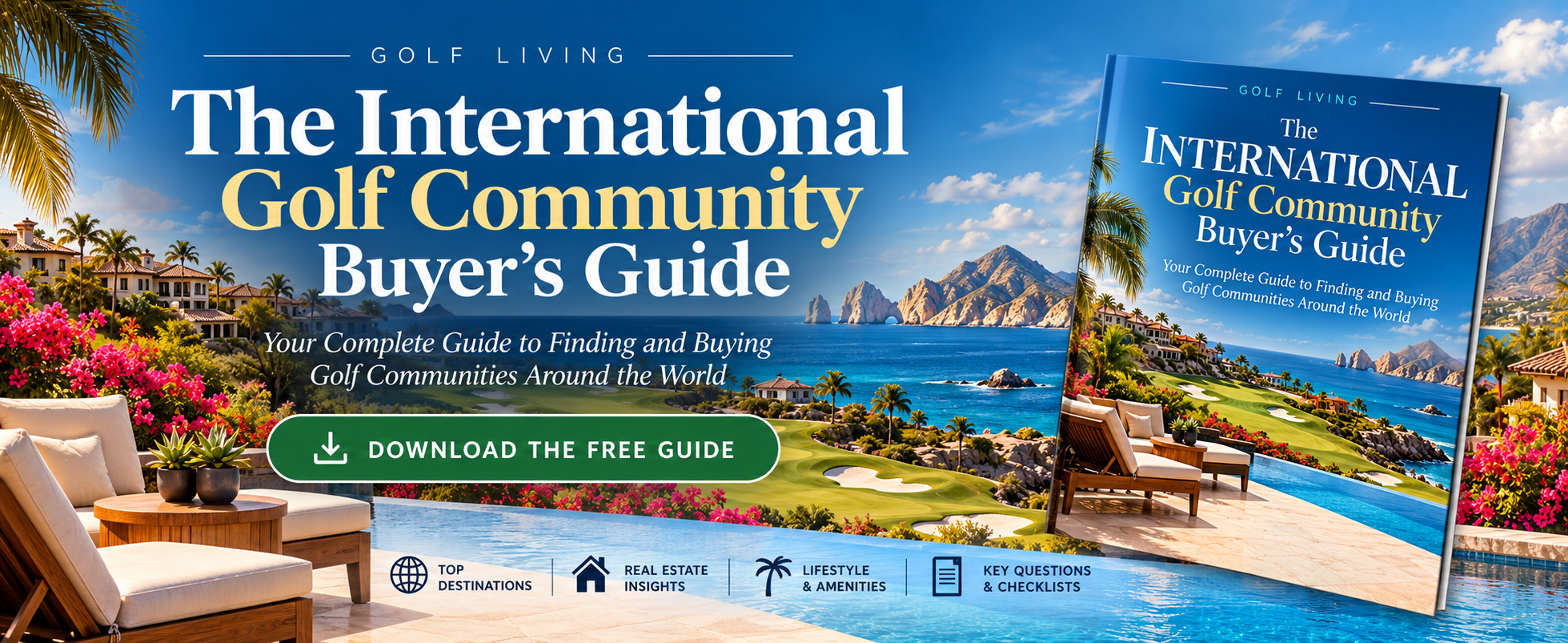
Buying in an International Golf Community Is Different
A golf home outside the United States is not just a second home. It is a real estate decision, a club decision, an immigration decision, a healthcare decision and a tax decision, all made in a country where the rules are different and the sales team works for the developer.
Many buyers fall for the view before they understand how they will hold title, whether the golf comes with the house, how long they can legally stay, or what the IRS expects every April. This guide helps you ask those questions before you buy, not after.
Whether you are considering a winter home in Los Cabos, a seasonal residence in the Dominican Republic, or a full retirement move to Costa Rica or Panama, start here. Then browse our international golf communities to compare destinations for retirement, seasonal living and second-home ownership.
Know What to Ask Before You Buy Abroad
- Destination profiles from Los Cabos and Punta Mita to Casa de Campo, Cabot Saint Lucia and the Algarve, with the honest downside of each
- How Americans own property abroad, including Mexico's bank trust and Costa Rica's Maritime Zone, in plain English
- Why buying a villa does not give you the right to live in a country full time, and the residency paths that do
- Club membership abroad: why buying the home may not include the golf, and how equity, non-equity and deposit memberships differ
- Pre-construction risk and how to protect your deposits on a project that is still being built
- Rental programs: management splits, owner usage and why you should ask for actuals instead of projections
- U.S. tax and reporting rules that follow you abroad, from foreign accounts to selling and estate planning
- A destination comparison matrix, printable due diligence checklist, true cost of ownership worksheet and a 12-month relocation timeline
- The 20 questions to ask the developer and the golf club before you sign anything
Get the International Golf Community Buyer's Guide
Complete the form below for immediate access to the International Golf Community Buyer's Guide.
The Short Version: Buying a Golf Home Abroad
Here is the guide in brief, no form required. It is January, the greens back home are under covers, and owners at Diamante, Casa de Campo and Punta Mita are teeing off in seventy-five degrees. That is the case for owning abroad. What follows is everything the sales presentation tends to skip.
Owning a Home Is Not the Same as Living There
How you plan to use the home changes almost every rule in this guide. A second-home owner who spends a few weeks a year in Los Cabos never needs a residency card. A seasonal resident who stays three to six months may bump into tourist-stay limits. A full-time relocator to Panama absolutely needs residency, healthcare, banking and a tax plan. Decide which buyer you are first.
Then take the partner test. In our experience the strongest predictor of whether an international home works out is whether both partners are genuinely enthusiastic, not one excited and one along for the ride. If it is the second, it tends to surface by year two.
Where Americans Are Buying Golf Homes Abroad
- Los Cabos, Mexico. The deepest international golf real estate market by a wide margin: Diamante, Chileno Bay, Querencia, Cabo del Sol, Quivira and Palmilla. Inside the gates it is no longer inexpensive, and Hurricane Odile in 2014 is why construction standards deserve scrutiny.
- Punta Mita and the Riviera Nayarit, Mexico. Two Nicklaus courses on a gated peninsula, including the optional par 3 Tail of the Whale to a natural island green. Exclusivity shows up in the dues.
- Riviera Maya, Mexico. Mayakoba and El Camaleon headline, with Cancun one of the best-connected airports for Americans. Hurricane exposure, seasonal sargassum and a wave of risky pre-construction near Tulum are the trade.
- Dominican Republic. Teeth of the Dog at Casa de Campo, plus Corales and Punta Espada in Punta Cana. Foreigners can hold title directly, but title disputes have been more common here, so a full title search and title insurance are not optional.
- Guanacaste, Costa Rica. Fewer courses, remarkable settings at Peninsula Papagayo, Reserva Conchal and Hacienda Pinilla. Liberia airport is the convenient one. The rainy season runs roughly May through November.
- Panama. Chosen more for residency and the U.S. dollar than for golf depth, with Nicklaus courses at Buenaventura and Santa Maria. Year-round heat and a long rainy season.
- The Bahamas. Albany, Lyford Cay, Ocean Club and Baker's Bay. No personal income tax locally, a 10 percent VAT on purchases by non-Bahamians, and squarely in hurricane territory.
- Puerto Rico. Dorado Beach and Grand Reserve, with no passport, no immigration process and Medicare that still applies. Plan on a whole-home generator.
- Portugal and Spain. Quinta do Lago, Monte Rei, Valderrama and Sotogrande. The real estate golden visa is gone in both countries, and becoming tax resident can mean local tax on worldwide income.
Saint Lucia, Barbados, St. Kitts, Scotland, Ireland and Canada are covered in the full guide too, along with a candid note on places that make every retire-abroad list but have very little golf worth the move.
How Americans Hold Title, Destination by Destination
| Destination | How Americans hold title | Residency path for longer stays | Hurricane exposure |
|---|---|---|---|
| Los Cabos, Mexico | Bank trust (fideicomiso) | Temporary residency, income-based | Moderate |
| Punta Mita, Mexico | Bank trust (fideicomiso) | Temporary residency, income-based | Moderate |
| Riviera Maya, Mexico | Bank trust (fideicomiso) | Temporary residency, income-based | High |
| Dominican Republic | Direct title | Law 171-07 residency | High |
| Guanacaste, Costa Rica | Direct title, except the Maritime Zone | Pensionado, 1,000 dollars a month | Low |
| Panama | Direct title | Pensionado, 1,000 dollars a month | Very low |
| The Bahamas | Direct, with registration | Economic PR at a 1 million dollar purchase | High |
| Puerto Rico | Direct (U.S. territory) | None needed | High |
| Portugal and Spain | Direct title | Income-based visas only | None |
Golf depth, price ranges and flight times for each destination are in the full comparison matrix in the guide. Visa thresholds and property rules change often, so confirm current requirements with local counsel.
Buying the Home May Not Include the Golf
This is the most common surprise for American buyers abroad. In some communities membership conveys with the residence. In others it is a separate purchase with its own initiation fee. In others, owners just get preferred rates at a resort course, and in a few there is a waiting list.
Then ask the resort guest question. At resort-community courses, owners and hotel guests often share the tee sheet, and in February with the hotel full that can mean no owner tee times before early afternoon. Ask how tee times are actually allocated in peak season, and ask current owners, not the sales team.
Pre-Construction Is Where Buyers Get Hurt
Most international golf communities are financed partly by selling homes before they are built. Many buyers do well this way. The ones who do not tend to meet the same four problems: two-year projects that become four-year projects, a finished home that does not match the rendering, a second course or beach club that stays a future phase forever, and a developer that runs out of money while holding your installments. Use escrow tied to milestones, and if an amenity is only in the brochure, it is not a commitment.
Rental Income: Ask for Actuals
Rental income shows up in nearly every presentation, and it can carry a real share of your carrying costs. It is rarely the return the pro forma suggests. An even split of net revenue is common in resort and branded programs, before management, housekeeping and reserve charges. Your peak season is everyone's peak season, which is also when you will want to be there. Ask for three years of actual results on comparable homes. A program that will only share projections is telling you something.
The IRS and Medicare Do Not Move With You
The United States taxes its citizens on worldwide income wherever they live. Owning abroad adds reporting, and a local bank account for the housekeeper and utilities usually triggers an FBAR. The Foreign Earned Income Exclusion covers wages, not Social Security or pensions, so it rarely helps retirees. Foreign property also passes under local law, not your U.S. will.
Medicare generally ends at the border. Puerto Rico is the exception. Everyone else needs international or local health coverage, and medical evacuation coverage if the community is an hour or more from a hospital that can handle a cardiac or stroke emergency.
The 30-Day Test
The single most valuable piece of advice in the guide: rent for at least 30 days in the community before you buy, ideally once in high season and once in low. Play the course on different days, time the drive to the hospital, fly in and out at the times you actually would, and spend a rainy day there. At the end, ask your partner candidly whether you can see yourselves there. The full guide includes the test-stay checklist.
Buying a Golf Home Abroad: 10 Questions Americans Ask
Short answers to the questions we hear most. The guide goes deeper on each, and adds the 20 questions to put to the developer and the club before you sign.
1. Can Americans own beachfront property in Mexico?
Yes, through a bank trust called a fideicomiso. Mexico bars foreigners from holding direct title within 50 kilometers of the coast, which covers Los Cabos, Punta Mita and the Riviera Maya. A Mexican bank holds title and you hold the rights to use, rent, sell and leave the property to heirs. The trust runs 50 years and is renewable.
2. Does buying a home abroad give you residency?
Usually not. Owning a home does not by itself give you the right to stay longer than a tourist visit. The main exception in the guide is the Bahamas, where a purchase of 1 million dollars or more qualifies you to apply for Economic Permanent Residency. Spain ended its real estate golden visa in April 2025, and Portugal stopped accepting real estate in October 2023.
3. Does a golf membership come with a home in an international golf community?
Not always. In some communities membership conveys with the home, in others it is a separate purchase with its own initiation fee, and in some owners only get preferred rates at a resort course. Get the membership terms in writing before you commit to the view.
4. Does Medicare cover you if you live abroad?
Generally no. For planning purposes, assume Medicare coverage ends at the border. Puerto Rico is the exception because it is a U.S. territory. Owners abroad need international health insurance, local coverage or both, plus medical evacuation coverage in remote areas.
5. Do I still have to file U.S. taxes if I own a home or live abroad?
Yes. The United States taxes citizens on worldwide income wherever they live. Owning abroad also brings reporting rules, including the FBAR when combined foreign account balances exceed 10,000 dollars at any point in the year. Work with a tax advisor who specializes in Americans with international assets.
6. What are typical closing costs on an international golf home?
The guide uses 3 to 10 percent of the purchase price as a working estimate for transfer taxes, notary and registry fees, legal fees, title insurance and trust or entity setup. The Bahamas runs higher because of the 10 percent VAT on purchases by non-Bahamians. Get a written estimate from your attorney before you make an offer.
7. Which countries have the easiest retirement residency for Americans?
Panama's Pensionado program is the best known. It requires a lifetime pension of 1,000 dollars a month, or 750 dollars with Panamanian real estate worth 100,000 dollars or more, and Social Security qualifies. Costa Rica's Pensionado also starts at 1,000 dollars a month, and the Dominican Republic offers Law 171-07. Thresholds change, so confirm them with local counsel.
8. Is buying pre-construction in an international golf community safe?
It can work, and many buyers have done well. The risks are delays, a finished product that differs from the rendering, promised amenities that never get built, and a developer that runs short of capital. Use escrow tied to construction milestones, write every promised amenity into the contract, and have your own attorney review it.
9. How much rental income can an international golf home earn?
Less than the pro forma, usually. In resort and branded rental programs an even split of net revenue is common, and the owner's share is then reduced by management, housekeeping and reserve charges. Ask for three years of actual results on comparable homes, not projections.
10. What happens to a home abroad when the owner dies?
Foreign real estate passes under the law of the country where it sits, not your U.S. will. You may need a local will, some countries have forced heirship rules or inheritance taxes, and in Mexico naming substitute beneficiaries in the fideicomiso can let heirs take over without local probate.
Get the Full Guide
The free PDF runs 46 pages and adds what this page leaves out: full destination profiles, the comparison matrix with golf depth, price tiers and flight times, residency requirements country by country, the due diligence checklist, the true cost of ownership worksheet, the 20 questions for the developer and the club, and a 12-month relocation timeline.
Download the Free GuideThis guide is editorial and informational, not legal, tax, immigration, investment or financial advice. Visa thresholds, tax rules and property laws change often. Figures are current as of October 2026. Retain an independent attorney in your destination country and a U.S. tax advisor before you buy.